- Biweekly AI, Data & Analytics Digest
- Posts
- Platform Decisions That Will Matter in 2026, Why Pipelines Are Being Built for Machines, and the State of LLMs
Platform Decisions That Will Matter in 2026, Why Pipelines Are Being Built for Machines, and the State of LLMs
Biweekly Data & Analytics Digest: Cliffside Chronicle

Josh Miramant
14 Jan • Estimated Reading Time: 3 minutes

Data & AI Strategy in 2026: The Lakehouse Grows Up

Databricks lays out what it sees as the defining priorities for data and AI leaders heading into 2026: unifying data and AI on a single platform, operationalizing generative AI beyond experiments, and getting serious about governance as regulatory and risk pressures rise. The article frames the lakehouse as the control plane for analytics, ML, and GenAI (emphasizing shared data foundations, embedded governance, and tighter integration between data engineering, BI, and AI workloads). Fragmented stacks and “innovation theater” won’t scale, and leaders need platforms that can support production-grade AI, not just notebooks and demos.
The push toward a unified data + AI platform is less about technology maturity and more about organizational readiness. The lakehouse works when teams align on data contracts, ownership, and operating models. Without that, you just centralize chaos faster. We also think many leaders underestimate how different GenAI workloads are from traditional analytics: latency, cost unpredictability, evaluation, and governance all behave differently.
Databricks is right to emphasize governance-by-design, but tooling alone won’t save teams that haven’t modernized how they build and ship data products.
Your Data Pipelines Aren’t for Humans Anymore
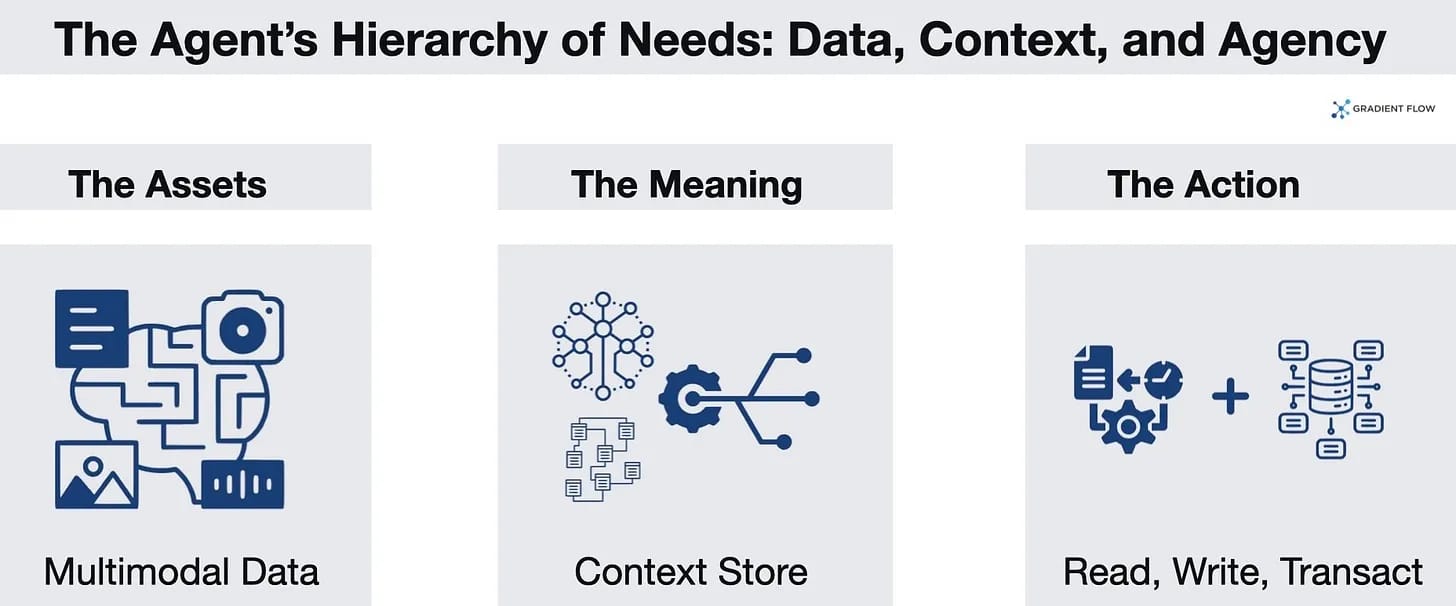
Data engineering has historically optimized for human consumers, but the next wave of consumers are machines. Models, agents, and automated systems now rely on data that must be consistent, well-labeled, versioned, and available with predictable latency. The article reframes pipelines as products for “machine users,” where schema stability, semantic clarity, and automated validation matter more than flexibility or one-off analysis.
Teams say they’re “AI-ready,” but their pipelines are still built for BI-era workflows: late data, mutable schemas, tribal knowledge, and manual fixes. That works when a human can sanity-check a dashboard, but it fails when an agent is making decisions in real time. Designing for machine users forces harder conversations around data contracts, feature versioning, and platform guarantees. It also exposes why tools like feature stores, data quality checks, and lineage are table stakes.
When Your Data Stack Starts Thinking Back

Metadata is evolving from passive documentation into an active infrastructure layer for agentic systems. As AI agents increasingly query data, trigger actions, and chain tools together, they need context: lineage, semantics, ownership, freshness, and intent. The piece frames “agentic metadata” as metadata that can be queried, reasoned over, and acted on by machines, enabling agents to choose the right data, validate assumptions, and even self-correct when things go wrong.
Agents need something different: machine-readable semantics, real-time freshness signals, and APIs that expose trust and relevance, not just column names. Platforms that treat metadata as a first-class, queryable system will enable safer automation. Those that don’t will end up hard-coding assumptions into agents.
If agents are going to act on your data, how will they know what to trust?
Benchmaxxing, Reasoning, and the Real Limits of Scale

Sebastian Raschka’s State of LLMs 2025 is a fortified year-end review that parses what actually moved the needle in large language models this year. Reasoning and structured learning signals overtook brute scaling and benchmarks themselves became a theme “Benchmaxxing” (optimizing for leaderboard scores that don’t reflect real-world capability) is now a recognized trend. Raschka also lays out how inference-time scaling and tool integration have become core levers for practical performance, while the broader ecosystem wrestles with limitations in benchmarks, training cost, and continual learning.
Raw parameter count isn’t a useful proxy for value, and focusing on reasoning patterns, post-training strategies, and reliable inference payloads matters far more for real use cases. The rise of open-weight reasoning models suggests cost structures might finally bend toward accessibility, not just monopoly-level compute spend. For mid-market technical leaders, this means evaluating LLMs through the lens of task fit, cost predictability, and integration maturity.
2026 Data Predictions: The End of “Modern” Data Stacks as We Know Them

The so-called “modern data stack” is fragmenting under its own complexity. Key predictions include a consolidation around fewer platforms, renewed focus on cost efficiency over experimentation, and a shift away from dashboards toward operational and embedded analytics. AI plays a role as a forcing function exposing weak data foundations.
The biggest data problems in mid-market orgs is a lack of coherence. Teams are drowning in ELT jobs, semantic layers no one trusts, and BI sprawl that doesn’t drive decisions. AI only amplifies the pain. When data quality, lineage, or ownership is unclear, automation fails fast and quietly.
2026 will reward teams that simplify aggressively: fewer platforms, clearer data contracts, and analytics that live closer to business workflows.
Snowflake + Gemini 3: Platform Wars Are Now AI-Native

Snowflake wants to be a first-class AI platform, not just a data warehouse with SQL and dashboards. By embedding Gemini directly into Cortex, Snowflake is positioning GenAI as a native workload (alongside analytics, governance, and data sharing). The pitch is familiar but evolving: keep data in place, apply models securely, and abstract away infrastructure complexity for enterprise teams.
Every major player is converging on the same promise: AI where the data lives. What we’ve seen in practice is that GenAI inside the warehouse is compelling for augmentation use cases (summarization, classification, copilots), but brittle for anything requiring real-time orchestration or complex reasoning loops.
Are you choosing platforms based on marketing momentum, or on how well they support production AI realities?
Blog Spotlight: AI in ERP Systems: Real-Time Insights and Predictions
This article breaks down how embedding AI directly into ERP workflows enables real-time forecasting, anomaly detection, and predictive recommendations across finance, supply chain, and operations. The key shift is moving analytics from a downstream reporting layer into the transactional core of the business. When AI is tightly coupled with ERP data, forecasts update as conditions change, exceptions surface before they become problems, and teams can act with context instead of gut feel. AI delivers value in ERP not when it replaces systems, but when it augments them exactly where work already happens.
“Automation applied to an inefficient operation will magnify the inefficiency.”